
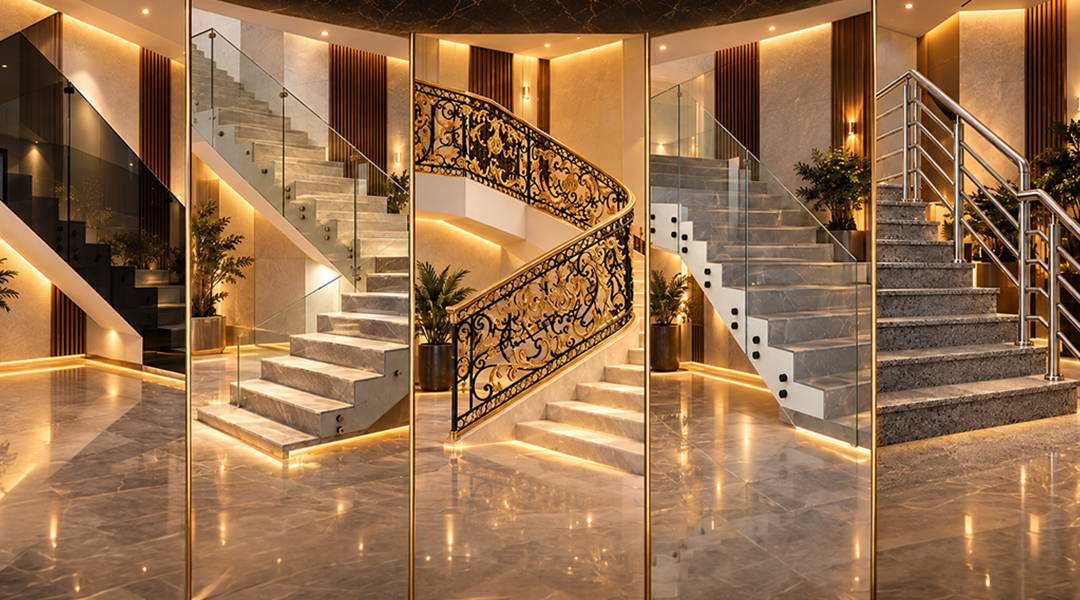
Stair railings influence both the look of your home and how you use it every day. Glass can make a staircase feel lighter and more open, wood adds warmth, and iron offers designs ranging from simple lines to classic decorative details.
Choosing the best stair railing for your home, however, takes more than comparing photos. You also need to consider how comfortable the handrail is to hold, how the system is secured, the available passage width, ease of cleaning, and whether the design suits children and older adults.
In this guide, we compare five popular materials and explain how to choose between them based on your home’s style, everyday needs, and budget.
What to Consider Before Choosing a Material
Start with the railing’s purpose. A stair railing forms a protective barrier along the open side of a staircase or landing. The handrail is the part you hold for support when going up or down. These can be combined in one design, or a separate handrail can be mounted on the wall.
Key considerations include:
Design and installation safety: Heights, openings, loads, and fixing points should be checked against the project requirements and applicable building code.
Comfort: A comfortable grip, smooth surfaces without sharp edges, and a continuous path for your hand.
Staircase width: Allow for the space taken up by posts, handrails, and bases when calculating the clear passage width.
Location: An indoor staircase in an air-conditioned home faces different conditions from an outdoor staircase exposed to sunlight and moisture.
Who will use it: Children and older adults may have different needs when it comes to openings, layouts, and handrails.
Maintenance: Some designs show fingerprints easily, while intricate decorative details take more effort to clean.
Repair options: Ask how a glass panel, wooden component, or fitting can be replaced if needed.
The material alone does not determine safety. A railing may look sturdy while its fixing method or design details still need attention. Ask for a drawing showing the complete system before fabrication begins.
Glass Stair Railings
Glass railings suit homeowners who want to preserve natural light and clear sightlines, particularly in modern interiors or where the staircase sits at the centre of the home. Their transparency also allows marble or wooden stairs to stand out.
Fixing options include metal posts, continuous base channels, side-mounted systems, and other solutions designed for the location.
When choosing a glass railing, discuss:
The glass composition, thicknesses, and treatment.
Panel dimensions and how they will be supported.
The bases and fixings, and their suitability for the supporting structure.
Edge finishes and gaps between panels.
Whether a separate or top-mounted handrail is needed.
How a damaged panel can be replaced.
Describing the glass as “tempered” is not enough to approve the entire system. The National Glass Association explains that laminated glass offers benefits in railing systems, including the tendency for fragments to remain attached to the interlayer after breakage, helping retain the glass within the system. The appropriate glass specification still needs to be approved for the design and project requirements.
Maintenance includes cleaning fingerprints and water marks, along with inspecting fittings and joints according to the system’s care instructions.
Stainless Steel Stair Railings
Stainless steel railings create a distinctive metallic look. They are available in polished or brushed finishes and can be used on their own or combined with glass and wood.
When inspecting a sample or completed installation, check the consistency of the welds, the finish at connections, the alignment of the posts, and the comfort of the handrail. These details affect both appearance and everyday use.
Stainless steel needs appropriate care. A build-up of contaminants or unsuitable cleaning products can affect its surface. Ask for cleaning instructions rather than assuming it requires no maintenance.
Iron Stair Railings
Iron railings offer considerable design flexibility, from understated vertical bars to decorative patterns and traditional detailing. Depending on the design, they can suit a modern staircase or a villa entrance with a classic style.
Before approving the design, review:
Section dimensions and wall thicknesses.
The arrangement of posts and openings.
Weld quality and the finish at connections.
Fixing methods and base details.
Surface preparation, corrosion protection, and paint.
How scratches can be repaired and the finish renewed.
For outdoor staircases, corrosion protection becomes especially important, along with the treatment of welds and areas where water might collect.
Simple designs are generally easier to reach and clean than intricate decorative work. Choose details you can comfortably maintain over time.
Wooden Stair Railings
Wooden railings bring warmth to a space and work well with timber flooring, soft colours, and both classic and contemporary interiors.
Wood can be used for the entire railing or just the handrail, paired with metal posts or glass panels. This combination lets you enjoy its appearance and feel without overwhelming the space.
Check the wood species, how it has been dried, the assembly method, finish quality, and the treatment of joints and ends. For outdoor use, request specifications intended for that environment.
Maintenance involves checking for scratches, wear in the protective finish, and the condition of joints, with refinishing as needed. Wooden surfaces cannot all be repaired in the same way, so ask about the recommended repair method before buying.
Aluminium Stair Railings
Aluminium railings come in a variety of designs, colours, and finishes. They can be used in simple arrangements or combined with glass.
Aluminium is relatively lightweight, but weight alone does not determine railing quality. The sections, connections, and fixings need to be assessed as a complete system.
Pay attention to:
Section dimensions, wall thicknesses, and reinforcement.
The rigidity of the assembly and quality of the connections.
Whether the coating is suitable for indoor or outdoor use.
Compatibility between fixings and any metals in contact with one another.
Availability of replacement parts in the same colour and finish.
Choosing aluminium does not eliminate maintenance. Regular care still includes cleaning the surface and checking the coating, connections, and fixings.
How Is the Cost of a Stair Railing Calculated?
Quotes may be based on a price per linear metre or a total project price. In either case, the measurement method should be clear. Does the quote cover sloping sections and landings? How are curves, ends, and bases calculated?
The cost also depends on the shape of the staircase, the number of corners, site access, the condition of the supporting structure, and whether an existing railing needs to be removed or surrounding finishes altered.
Compare the full scope of work and specifications. Check whether moving materials to the installation area, installation, tax, and resolving any outstanding issues are included.
Matching the Railing to Your Home’s Style
For a modern staircase, look for clean lines and details that complement the interior architecture. Suitable options might include glass with minimal framing, iron with simple vertical bars, aluminium in a muted colour, or a combination of wood and metal.
A classic look can be achieved with decorative ironwork, shaped wooden elements, or carefully chosen metal details. A design does not need to be elaborate to feel elegant. The proportions of the components relative to the staircase width have a strong influence on the result.
When comparing designs, consider:
The colours of the stairs and flooring.
The style of doors, handles, and lighting.
The height of the space and the amount of natural light.
How visible the staircase is from the entrance or reception room.
The amount of decorative detail already in the space.
For villa staircases extending across several floors, check how the lines continue through landings and turns. A design that looks attractive along a straight flight also needs well-resolved details wherever it changes direction.
Choosing Railings for Homes with Children or Older Adults
In these homes, ease of use and protective details should guide the design.
Homes with Children
Discuss openings between components and beneath the railing in line with the project requirements.
Avoid details that make climbing easier, such as horizontal elements arranged like a ladder.
Address sharp edges and projecting decorations.
Keep climbable furniture away from the open side of the staircase.
Assess the complete system and its fixings rather than judging safety by the transparency of the glass or the appearance of the posts.
Homes with Older Adults
Choose a comfortable handrail that is easy to grip.
Check its continuity and the space available for fingers around brackets and beside the wall.
Discuss handrails on both sides, depending on the staircase width and users’ needs.
Choose a handrail that is easy to distinguish visually from the background.
Test its feel and avoid projections that interrupt the movement of the hand.
Consider stair lighting and clearly visible step edges alongside the railing design.
A wide or flat top edge may not provide a comfortable grip. A separate handrail that complements the design can be added where needed.
Combining Different Materials
Combining materials can help balance appearance, comfort, and practical use, provided the connections are carefully designed and responsibility for their installation is clear.
Possible combinations include:
Glass with a wooden handrail: Preserves light while adding a warm touch.
Glass with stainless steel: Creates a contemporary look with visible metal details.
Iron with a wooden handrail: Combines the design flexibility of iron with the character of wood.
Aluminium with glass: Offers a choice of colours alongside carefully planned transparency.
Before approving a combination, review how the materials meet, the compatibility of the fixings, how material movement will be accommodated, and whether one part can be replaced without damaging the others. Corners and connections should also remain easy to clean and comfortable to hold.
What Works Best for a Narrow Staircase?
No single material is right for every narrow staircase. Glass can make the space feel less crowded, but the deciding factor is how far the railing, handrail, and bases project into the walking area.
Ask for a drawing showing the clear passage width after installation. Side mounting may be an option in some locations if the supporting structure and structural design allow it, but it is not automatically suitable for every staircase.
What to Prepare Before Requesting a Quote
Gather photos of the stairs and landings, any available drawings, approximate lengths, the number of floors and corners, and details of the stair finish.
Explain whether the installation is indoors or outdoors, your preferred material and design, the condition of the site, whether an existing railing needs removing, and any needs relating to children or older adults. Final measurements and fixing points should be confirmed after a site survey.
Frequently Asked Questions
Are Glass Stair Railings Suitable for Homes with Children?
They can be considered as part of a system designed and approved for the intended use, with suitable glass composition, fixings, gaps, and edge details. Glass alone does not guarantee safety. The design details and installation are essential parts of the assessment.
Which Railing Material Needs the Least Maintenance?
That depends on the environment, finish, and complexity of the design. Glass needs frequent cleaning to stay clear, iron needs checks on its protective coating, and wood requires care of its finish. Stainless steel and aluminium also need appropriate cleaning and inspection.
Ask for a care plan for the specific product rather than relying on a “maintenance-free” description.
Can a Railing Be Fixed Directly to Marble or Tiles?
The supporting structure beneath the finish and the way loads will be transferred to it need to be checked. Marble or tiles alone should not be assumed to provide an adequate structural fixing base. Ask for a detail showing the fixings, their positions, and how penetrations through the finishes will be treated.
Choosing the best stair railing for your home starts with the shape of the staircase and the needs of the people using it. From there, compare materials, fixing systems, and maintenance requirements. Browse Metal World’s products and send photos and drawings of your staircase through the official website to request suitable options and a quote with clear specifications.