
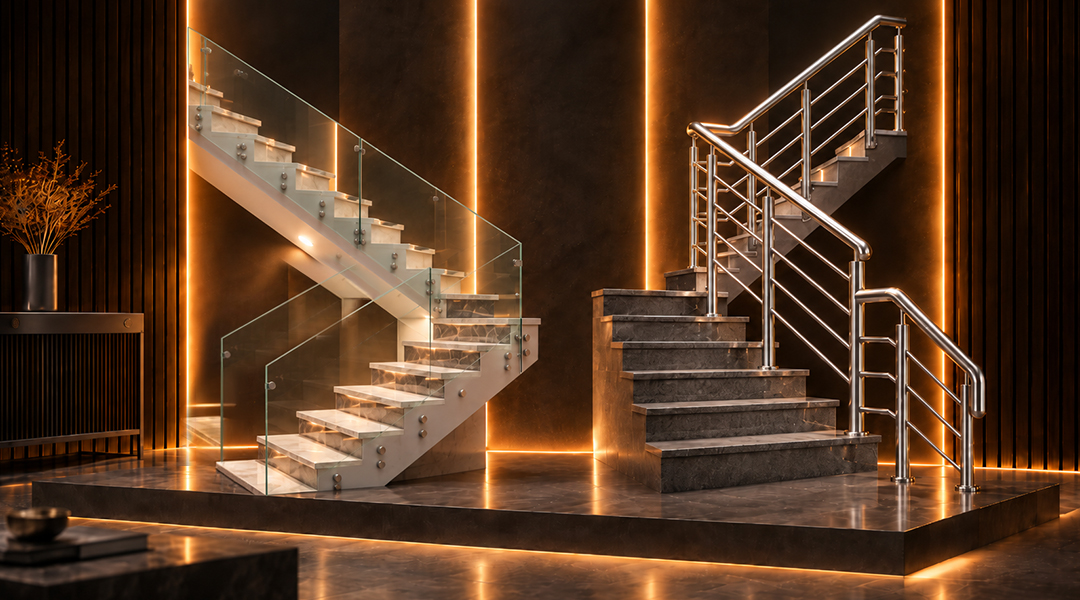
When designing a staircase or renovating a balcony, one question often comes up: should you choose glass or stainless steel railings? Glass creates an open feel and lets light flow through the space, while stainless steel adds a distinctive metallic touch and offers a wide range of design options. But the right choice goes beyond appearance. It also depends on where the railing will be installed, how it will be used, the quality of the installation, and your budget.
Sometimes, the best solution is a combination of both materials. In this guide from Metal World, we explore the key differences to help you choose a railing that suits your home, along with what to check before moving ahead with installation.
The main difference lies in the material that forms the protective barrier and how it is secured within the railing system.
Glass railings use glass panels to form the barrier. These may be fitted between metal posts or secured in a purpose-designed base channel. Frameless glass railings minimise the visible posts and framing around the panels, but they still rely on a structural fixing system. Explore glass railing options here.
Stainless steel railings, on the other hand, usually consist of posts and a top handrail, with bars or other infill elements depending on the design. Glass can also be fitted within this framework, creating a system that combines metal and glass.
When comparing glass options, it helps to understand the terminology:
Tempered glass: Heat-treated glass that is stronger than ordinary glass of the same thickness and breaks into small pieces when shattered.
Laminated glass: Two or more layers of glass bonded with an interlayer that helps hold the fragments together if the glass breaks.
Tempered laminated glass: Glass that combines heat treatment with lamination. These terms describe two different properties that can be incorporated into the same panel.
This is why the term “safety glass” alone does not tell you whether a product is suitable for a railing. The glass composition and specifications need to match the system’s design and installation location.
A practical comparison starts with your priorities. Do you want to make the staircase a focal point, preserve the view, simplify cleaning, or keep installation costs within budget?
In terms of appearance, glass is a good choice if you want to maintain clear sightlines throughout your home. Stainless steel suits those who prefer the railing to stand out as part of the décor. As Pilkington explains, glass barriers provide physical separation while preserving light and visibility.
When it comes to cost, neither material is always the cheaper option. A custom stainless steel railing may cost more than a simpler glass system. Comparing prices per metre can also be misleading if one quote includes supply, installation, and finishing, while another covers materials only.
Both systems need regular care. To clean stainless steel railings, use a soft cloth and a suitable cleaner, then rinse and dry the surface. Avoid steel wool and cleaning products containing chlorine or hydrochloric acid.
For glass, follow the manufacturer’s care instructions for the panels and any surface coatings. Pay particular attention to corners, panel edges, and fixing points, where dust can collect.
Safety depends on the design of the entire system, rather than the material alone. A well-specified glass panel still needs suitable fixings. Similarly, a metal railing needs posts, sections, connections, and a supporting base designed to withstand the expected loads.
Before installation, ask for clarification on the following:
Material specifications: The glass composition and thickness, or the stainless steel grade, section dimensions, and wall thicknesses.
Fixing method: Where the railing will be anchored, which fixings will be used, and whether they are suitable for the supporting structure.
Barrier height and openings: Whether these meet local requirements and suit the intended use.
Edges and handrail details: Smooth edge finishes, a comfortable grip, and no sharp components.
System documentation: Technical specifications and any test reports or calculations required for the project.
For glass systems, also ask what happens if a panel breaks and how the design accounts for that possibility. Tempered and laminated glass behave differently when broken. Holding the fragments together does not, by itself, prove that the barrier will continue to carry the required loads.
There is no single glass thickness that suits every project. The right specification depends on panel dimensions, the fixing method, and the required loads. The same applies to the dimensions of stainless steel posts and sections.
For an indoor staircase, glass railings can be a good choice if you want to preserve natural light and show off wooden or marble steps. If you prefer metallic lines and a more prominent handrail, consider stainless steel or a combination of stainless steel and glass.
When choosing an indoor stair railing, check the staircase width and handrail position. An attractive design should also allow comfortable movement and provide a secure grip when going up or down.
For balconies, glass offers an open view, especially when the outlook is a major part of the space’s appeal. An outdoor system, however, also needs to account for wind and water exposure, drainage, and safe access for cleaning.
Stainless steel components need a grade and finish suited to the environment. Staining or surface discolouration can occur if the wrong grade is selected, fabrication is poor, or cleaning is neglected, particularly in environments exposed to salt.
A stainless steel railing with glass panels is worth considering if you want the transparency of glass alongside visible metal posts or a metal handrail.
This combination can work well for:
A modern staircase that brings together wood and metal.
A space where you want to preserve the view while adding a coordinated metal handrail.
A project where you want to compare the cost of glass panels fitted between posts with a frameless system.
A home where the railing finish should match other metal details.
The overall look can change considerably depending on the stainless steel finish, the number of posts, and the colour and transparency of the glass. However, combining the two materials does not automatically mean a lower cost or greater safety. Both depend on the system’s specifications and installation.
Start with what the space needs, then compare designs that meet those needs.
If your priorities are the view and natural light, explore glass options. If you prefer a stronger metallic presence and a wider choice of bar and post designs, start with stainless steel. If you want both looks, ask for a design that combines stainless steel and glass.
Next, request detailed quotes based on comparable specifications. A railing installation quote should clearly set out:
The lengths, dimensions, and method used to calculate quantities.
The glass specifications or stainless steel grade and sections.
The posts, handrails, fixings, and finishes.
Whether transport, installation, and preparation work are included.
The installation timeframe, warranty terms, and maintenance requirements.
Consider how easy the design will be to maintain, too. Large glass panels reduce the number of joints, but you still need suitable access to clean them. More intricate metalwork adds visual character, though it may take longer to clean around corners and details.
To make a choice that suits your home, gather photos and measurements of the space and decide on your priorities before requesting a quote from Metal World. This makes it easier to discuss specific options and understand how the cost of each design compares.
Are stainless steel railings always cheaper than glass?
No. Stainless steel costs vary depending on the amount and grade of metal, section thicknesses, and design complexity. Glass costs depend on the panel composition, dimensions, and fixing system. A simple stainless steel design may cost less than a frameless glass system, but that does not apply to every project. A fair comparison means comparing quotes that cover the same specifications and scope of work.
Are glass railings safe for children?
They can be suitable when designed and installed to meet safety requirements, using the right glass and fixing system. Continuous glass panels can reduce openings within the barrier, but gaps at the sides and below the panels still need to be checked. The design should also avoid features that make climbing easier. Good design, proper installation, and keeping climbable furniture away from the railing all play an essential role in safe use.