
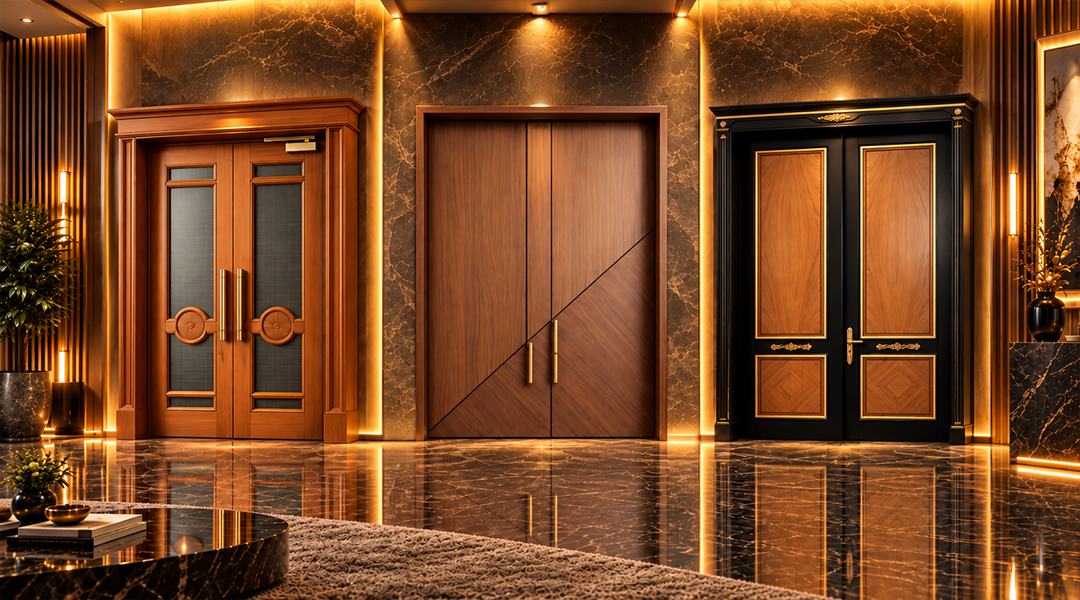
A bedroom door and a front door may share the same colour and design, but they serve different purposes. A bedroom door provides privacy and helps reduce sound transfer. An entrance door needs specifications suited to security and its location, and may also need to withstand sunlight, heat, and moisture.
The difference between interior and exterior doors therefore goes beyond appearance or thickness. It includes the materials, internal construction, frame, locks, finish, and installation method.
Before choosing doors for your home, distinguish between three locations: a door inside the home, an apartment entrance door in an enclosed corridor, and an exposed exterior door. Each setting has requirements that affect performance, lifespan, and maintenance costs.
Interior and Exterior Doors at a Glance
Interior doors separate spaces, manage movement between rooms, and provide privacy. Common examples include bedroom, bathroom, and home office doors. Exterior doors separate a home or building from its surroundings, with specifications that depend on exposure and security needs.
What About an Apartment Entrance Door?
An apartment door in an enclosed corridor may be sheltered from sunlight and rain, but it is still an entrance door. It needs suitable security, sound privacy, and specifications that meet the building’s requirements. Being indoors does not make it equivalent to a bedroom door.
Differences in Materials and Construction
The material name alone does not tell you how a door will perform. Wood, for example, can be used for both interior and exterior doors, but the construction, core, finish, edge treatment, and maintenance requirements may differ.
To compare door materials properly, consider the complete assembly:
Door leaf: The moving part of the door, including its outer surfaces and internal structure or core.
Frame: The structure fixed into the wall opening that supports the hinges and lock strike.
Hardware and seals: Hinges, locks, handles, seals, and any additional fittings.
Finish: The final surface coating, along with the preparation and treatment beneath it.
Installation: How the frame is secured to the wall and how the surrounding gap is treated.
Interior options include timber doors, solid-core and hollow-core doors, and composite materials such as wood-plastic composite (WPC). The right choice depends on sound privacy, moisture resistance, appearance, and budget.
For exterior doors, the product specifications must suit the installation location. Iron doors need appropriate protective treatments and finishes. Timber doors need construction and finishes suitable for their intended use. Aluminium door systems also vary in their construction, insulation, and sealing details.
Metal World’s range includes wooden, iron, and WPC doors, providing a starting point for comparing options by material and intended location.
When comparing products, ask for a written description of the door construction, frame, and finish. Labels such as “wooden door” or “waterproof door” do not provide enough detail on their own.
Differences in Security, Locks, and Hardware
A lock’s purpose depends on the door’s location. For a bedroom, the main goal is usually privacy. An entrance door needs to control access to the home and provide a suitable level of protection.
A strong lock alone, however, is not enough. An entrance door’s performance depends on the leaf, frame, hinges, lock, and wall fixings working together. A high-specification lock fitted to a weak door leaf or poorly secured frame will not deliver the expected benefit.
When choosing an entrance door, discuss:
The lock type and its compatibility with the door’s construction.
Reinforcement around the lock and hinge fixing points.
Whether the hinges suit the door leaf’s weight and dimensions.
The quality of the strike plate and its fixing within the frame.
Spare parts availability and ease of maintenance.
Compatibility with a smart or electric lock if you plan to install one.
For bathrooms, consider a privacy lock that can be released from outside in an emergency, using hardware appropriate to the project.
For exposed entrances, check that the locks, handles, and electrical components are suitable for moisture, dust, and outdoor conditions, as well as the door leaf itself.
Differences in Insulation and Resistance to Sunlight and Moisture
Thermal insulation, sound insulation, moisture resistance, and resistance to sunlight are separate properties. Good performance in one does not necessarily mean a door performs equally well in the others.
Thermal Insulation
Thermal insulation becomes more important when a door separates an air-conditioned room from the outdoors. Performance depends on the construction of the leaf and frame, the insulation materials, any glazing, and the effectiveness of the perimeter seals and threshold.
A metal door does not automatically provide good thermal insulation. Review the design of the complete system and any available performance data.
Sound Insulation
Sound privacy can be a key consideration when choosing room doors. Masonite, for example, explains that its solid-core doors help reduce noise transfer compared with its hollow-core doors.
However, gaps around and beneath the door also affect the result. A suitable door leaf with large gaps will not perform as well as a correctly installed and sealed assembly.
If you have a particular need, such as a bedroom beside a reception room or a home office, ask for acoustic test data for the proposed system instead of relying solely on a “soundproof” description.
Moisture Resistance
Resistance to humidity is different from resistance to repeated splashing, immersion, or water collecting at the base of the door. A door leaf may tolerate moisture while its edges, surface covering, frame, or hardware remain vulnerable if they are not specified and installed for the same conditions.
Ask about moisture resistance across the entire assembly, including the leaf, frame, finish, and metal components. Also confirm which cleaning methods are permitted.
Sun Exposure
A door near a window that receives several hours of direct sunlight faces different conditions from one in a shaded corridor. An exposed exterior entrance also needs materials and finishes suited to ultraviolet exposure and high surface temperatures.
Products have different limits, so request written guidance confirming suitability for direct exposure and any requirements relating to a canopy, colour choice, or maintenance.
How to Choose a Door for Its Location in Saudi Arabia
Conditions vary across Saudi Arabia and from one property to another. An entrance near the coast faces different exposure from a sheltered entrance farther inland. A west-facing door exposed to afternoon sun also faces different conditions from one beneath a deep canopy.
Start by identifying where the door will be installed and how exposed it will be. Then choose specifications suited to those conditions.
Bedroom and Bathroom Doors
For bedroom doors, focus on sound privacy, smooth operation, good-quality handles and locks, and a design that complements the rest of the home. Improving the door’s construction and sealing may contribute more to everyday comfort than additional decorative details.
Bathroom doors need further checks, including:
Whether the leaf and frame are suitable for the room’s humidity.
Whether the finish can withstand your usual cleaning method.
Protection of edges, cut-outs, and hardware openings according to the product instructions.
Hardware suitable for humid conditions.
Ventilation requirements when deciding on the gap beneath the door or any purpose-made vents.
Interior WPC doors are one option, but check the specifications of the particular product. A moisture-resistant material description does not explain its limits for water exposure, installation requirements, or warranty conditions.
Apartment Entrance Doors
An apartment entrance door in an enclosed corridor generally calls for greater attention to security, corridor noise reduction, and a well-sealed closure than to direct sun exposure.
Check the strength of the leaf and frame, the quality of the lock and hinges, the surrounding gaps, and ease of use for everyone in the household.
If your project requires a fire-rated door, ask for a documented rating covering the complete required assembly, including the leaf, frame, and associated hardware. The material name or a description such as “heavy-duty” does not establish fire resistance.
Do not assume that replacing a lock or adding a door viewer will automatically be suitable for every door. Some systems have specific instructions governing hardware preparation and modifications.
Exposed Villa Entrance Doors
First, clarify which entrance you mean: the gate in the boundary wall opening into the courtyard, or the villa’s main door separating the outdoors from an air-conditioned interior.
For a boundary gate, the priorities may be privacy, security, weather resistance, and smooth operation. For the building’s entrance door, thermal insulation and effective air and water sealing become additional considerations.
Before choosing, tell the supplier about:
The direction the entrance faces and how long it receives direct sunlight.
Any canopy and how much protection it actually provides.
Possible exposure to rain or irrigation water.
Proximity to the sea.
Thermal or acoustic insulation requirements.
Any glass, openings, or backing panels included in the design.
Then request specifications suited to those conditions, covering the finish, seals, threshold, and locks, along with maintenance requirements. A canopy can reduce exposure, but the product still needs to suit its installation environment.
Can an Interior Door Be Used Outdoors?
Using an interior door outdoors is not recommended unless the manufacturer confirms that the specific product is suitable for those conditions.
The door may look fine when first installed, then develop problems with continued exposure. These can include fading, damage to the surface covering, changes in dimensions, or difficulty closing. The effects vary according to the material, construction, and finish.
Adding paint or a canopy does not automatically make an interior door suitable for exterior use. Its limitations may lie in the core, adhesives, frame, or hardware.
Before using any door outdoors, confirm three things:
The product specifications permit exterior use.
The actual level of exposure falls within its stated conditions of use.
The warranty covers that application and installation method.
If the information is unclear, choose a system designed for the intended location and supported by documented specifications.
Frequently Asked Questions
Are All WPC Doors Suitable for Outdoor Use?
No. WPC refers to a category of composite materials. It does not guarantee that every door made from them can withstand sunlight, heat, and rain to the same extent.
Formulations, construction, surface coverings, and additives vary between products. For example, a BMTPC technical assessment for one WPC door system includes restrictions on installation locations and exposure to sunlight and water. Those restrictions apply to that particular system and illustrate why each product’s documentation matters.
If you want a WPC door for an exposed entrance, request written confirmation of its suitability for exterior use, exposure limits, and warranty conditions.
Does Door Thickness Alone Indicate Quality?
No. Thickness is one factor, but it does not reveal the type of internal core, the strength of the hinge and lock fixing points, the frame quality, or the level of insulation and finishing.
Two doors with the same thickness can perform very differently. Compare their internal construction, material specifications, hardware quality, and available test data, then assess the quality of installation.
Does Every Exterior Door Provide Thermal and Sound Insulation?
No. “Exterior” describes the intended application, but it does not define the level of insulation. Ask for product performance data and check the insulation, seals, frame, threshold, and any glazing, because these components work together.
Does the Frame Have to Be Made from the Same Material as the Door Leaf?
Not necessarily. It must, however, be compatible with the leaf and suitable for its weight, dimensions, installation environment, and fixing method.
For systems with specific performance ratings, follow the approved assembly configuration rather than substituting components without checking their suitability.
What Information Should I Prepare Before Requesting a Quote?
Prepare the number of doors, approximate opening dimensions, and photos of each location. Explain the purpose of each door and its exposure to sunlight and water.
Mention any requirements for sound privacy, thermal insulation, or locking hardware. Then request a quote that clearly specifies the leaf, frame, hardware, finish, and installation.
Choosing a door starts with understanding where it will be used. Once the conditions are clear, comparing materials and designs becomes much easier. Browse Metal World’s door range and send your project details through the official website to discuss suitable options for rooms, entrances, and outdoor spaces.