
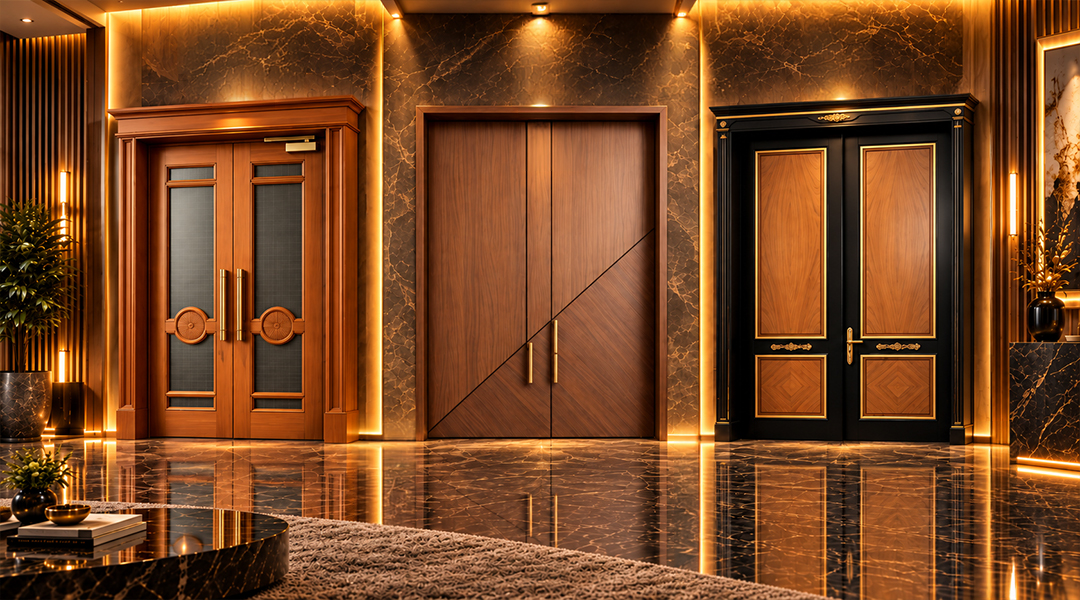
Choosing doors for your home goes beyond colour and design. A door that works well for a bedroom may not be the best choice for a bathroom. And while a glass door can make a reception room feel brighter and more spacious, it may not provide the privacy you need elsewhere.
When exploring the best types of interior doors, start with the purpose of each space. Do you need peace and quiet? Will the door be exposed to moisture? Is there enough room for a hinged door to open without hitting furniture?
Options include WPC, natural wood, MDF, aluminium, and glass, with different standards of construction, finishes, and hardware within each category. This guide compares materials and opening systems, highlighting what to check before requesting a quote.
How to Choose the Right Door for Each Room
Before comparing materials, consider what you need from the door in everyday use. In a bedroom, reducing noise may be the priority. In a bathroom, moisture resistance matters more. For a reception room, you may want an entrance that complements the décor and provides a comfortable passage width.
Start with these questions:
Where will the door be installed? In a bedroom, bathroom, reception room, office, or storage room?
How much privacy do you need? Do you simply want to block the view, or reduce sound transfer too?
Will it be exposed to humidity or water? How likely is moisture to reach the leaf and frame?
How much opening space is available? Will the door interfere with furniture or obstruct a passage?
How often will it be used? A door opened occasionally has different demands from one the family uses throughout the day.
What is your budget? Include the leaf, frame, hardware, and installation.
It helps to make a list of the doors you need and the purpose of each one. You do not have to use the same material throughout your home. Similar colours and design details can create a coordinated look while allowing the specifications to vary by room.
Interior Door Materials
The visible surface does not tell you everything about a door. Two doors may look alike but have different cores, frames, reinforcement, and methods of securing the lock and hinges.
Compare the complete assembly: the leaf, frame, finish, hardware, and installation method.
WPC Doors
WPC doors are made from composite materials containing wood-based components, polymers, and additives. Their formulation and construction vary between products.
They are available for bedrooms and bathrooms, particularly for buyers seeking a choice of designs and moisture-resistant properties. However, the specific model must be suitable for the intended use.
Before buying, check:
Leaf construction and thickness, including internal cavities or reinforcement.
Finish type and edge quality.
WPC frame specifications and fixing method.
Preparation for the lock and hinges.
Limits on water and heat exposure.
Warranty terms and cleaning instructions.
Moisture resistance does not mean a door can be submerged or continuously exposed to water. If it will be close to a shower or washed directly, request written confirmation that it is suitable for those conditions.
Natural Wood Doors
Natural wood interior doors bring warmth to a space and suit a wide range of styles, from classic to modern. Their finished appearance depends on the wood species, grain, construction, and finish.
When comparing products, clarify what “wooden door” means. Is it made from natural timber in a specified construction, or does it have a wood veneer over a different core? Both may serve a useful purpose, but they are different products.
Important details include:
The wood species, treatment, and drying process.
How the leaf is constructed and assembled.
Finish quality on both faces and all edges.
Whether the hinges are suitable for the door’s weight.
Care instructions and restrictions for humid locations.
Some wood finishes allow repairs or refinishing, but this depends on the door’s construction, the depth of the damage, and the surface finish. Ask about maintenance and repair options before making your choice.
MDF and Engineered Wood Doors
MDF, or medium-density fibreboard, is an engineered wood panel that may be used for door faces or other components in different constructions. The term “MDF door” therefore does not, on its own, describe the internal core or the performance of the complete door.
These materials provide surfaces suited to painting and a variety of designs, including routed details and the clean lines often used in modern interiors.
Check the board grade and its intended application. Standard boards designed for dry interiors differ from moisture-resistant grades.
Inspect the surface covering or paint, sealed edges, and the treatment of cut-outs for locks and hinges. Do not rely on the board’s colour alone to identify its grade.
Aluminium Doors
Interior aluminium doors range from solid-panel designs to systems combining metal profiles with glass or other infill materials. Depending on the system specifications, they can be considered for bathrooms, kitchens, utility rooms, and contemporary interiors.
Aluminium does not rot like wood-based materials, but the door’s performance still depends on the quality of the profiles, finish, connections, and hardware.
Before choosing, inspect:
The rigidity of the profiles and how they are assembled.
The panel or glass used within the leaf.
The quality of seals and joints.
Smooth operation of the hinges or sliding mechanism.
Hardware suitability for humid conditions.
The sound privacy provided by the complete system.
Do not assume that all aluminium doors offer similar insulation or feel the same when closing. Construction, infill materials, and sealing can make a noticeable difference.
Glass Doors
Glass doors allow light to move between spaces. They can work well in reception rooms, offices, and internal partitions where brightness and an open feel are priorities.
Options include clear, frosted, and patterned glass, but privacy depends on the treatment, lighting, and viewing distance. Frosted glass may obscure details while still allowing silhouettes and movement to be seen.
Comparing Materials by Use, Maintenance, and Cost
This table can help narrow your options, but it should be used alongside the specifications of the actual products.
Is One Material Always the Cheapest?
Interior door prices cannot be ranked accurately by material name alone. A door with a specialist finish and high-specification hardware may cost more than a simpler door made from another material.
Non-standard dimensions, the number of leaves, opening mechanism, frame type, locks, transport, and installation all affect the final price. Compare quotes based on the same dimensions and scope of work.
Choosing Doors for Bedrooms, Bathrooms, and Reception Rooms
Bedroom Doors
Privacy and smooth operation are priorities, especially if the bedroom is near a reception room, television, or children’s play area.
Look for construction that helps reduce sound transfer, a suitable lock, a properly aligned frame, and consistent gaps. Options may include timber or engineered wood doors with an appropriate core, or WPC doors supported by suitable product data.
If quiet is essential, ask for acoustic performance data rather than relying on descriptions such as “heavy-duty” or “soundproof.”
Bathroom Doors
Start with the actual conditions in the bathroom. Is the door away from the shower? Is ventilation adequate? Does water reach the bottom of the door during cleaning?
Compare WPC, aluminium, and other systems approved for the intended use, reviewing the leaf, frame, finish, and hardware together.
Consider a privacy lock that can be released from outside in an emergency. Ventilation requirements should also be agreed before deciding on the bottom gap or any ventilation openings.
Reception Room Doors
Reception room doors combine appearance with practical needs for movement and privacy. A wide opening may call for double doors. A solid door may help reduce the transfer of conversation, while glass can allow light through.
Think about how the door connects guest circulation routes with family spaces. The right design should allow comfortable movement and maintain the privacy you need when open and closed.
For a coordinated appearance, use consistent colours, handles, and design lines while adapting the material and construction to each room’s purpose.
Hinged, Sliding, and Folding Doors: What Is the Difference?
The opening method affects furniture placement, clear passage width, how well the door seals, and maintenance access.
Hinged doors are worth considering when privacy and effective sealing are priorities, provided suitable hinges, locks, and seals are selected.
Sliding doors can help where a swinging leaf would interfere with furniture or the available space. However, conventional wall-mounted sliding doors may leave gaps that allow more sound through than a well-sealed hinged system.
Folding doors may suit cupboards or some internal partitions. Before using one for a bedroom or bathroom, assess the clear opening, hinge and track quality, and privacy requirements.
What Affects Sound Insulation and Closing Quality?
Door sound insulation depends on several elements working together, rather than leaf thickness alone.
These include:
Core construction: Hollow-core, solid-core, and specialist constructions differ in their ability to reduce sound transfer.
Sealing: Sound can travel through gaps around the sides and beneath the door.
Frame installation: The gap between the frame and wall needs appropriate treatment.
Glass and openings: Their construction and fixing methods affect performance.
Perimeter seals, thresholds, or drop-down acoustic seals: These must suit the system and its intended use.
Lock and hinge adjustment: Correct adjustment helps the leaf remain stable and close properly.
In its comparison of solid-core and hollow-core doors, Masonite explains that its solid-core doors reduce noise transfer more effectively than its hollow-core alternatives. Actual performance, however, still depends on how the complete assembly is installed and sealed.
If you have a specific acoustic requirement, ask for a test rating such as STC or Rw. Check whether it applies to the leaf alone or the complete tested door assembly. Ratings produced using different test methods should not be treated as directly equivalent.
Avoid sealing every gap without checking the design requirements. Ventilation and movement clearances may need to be coordinated.
Test the closing action yourself. The door should move without scraping, the lock should work without lifting the leaf or pushing hard, and the surrounding gaps should remain even.
Common Mistakes When Buying Interior Doors
A design may look right while practical problems arise from details that were not settled early enough. Common mistakes include:
Using the same material everywhere without checking the conditions: Bedrooms and bathrooms have different requirements.
Judging by appearance or weight alone: Neither reveals the internal core or the quality of the fixings.
Assuming moisture resistance means continuous water resistance: Always check the product’s exposure limits.
Overlooking finished wall thickness: This can result in unsuitable frames or architraves.
Approving measurements before flooring is finalised: Changes in floor level affect the bottom gap and door movement.
Choosing sliding doors without planning movement and maintenance access: The track and the space where the open leaf rests need to be considered.
Comparing a leaf-only price with a complete door set: Align the included items first.
Ignoring the opening direction: The leaf may hit a cupboard or light switch, or obstruct a passage.
Failing to document the sample and specifications: Colour, handles, frames, and finishes should be clearly approved.
Accepting doors without testing them: Check every door and record any issues before completing handover.
Frequently Asked Questions
WPC or Wood: Which Is Right for You?
The choice depends on the location, desired appearance, and properties of the particular product. WPC may be worth considering where moisture resistance is a priority, once its usage limits have been confirmed. Wood may suit you if you prefer natural grain, detailing, and finishing options.
In either case, compare construction, frames, hardware, and warranty terms. Inspect an installed sample where possible. The material name alone does not determine the better choice.
What Should the Quote Include?
The quote should specify the door type and model, leaf construction, thickness and dimensions, frame and architraves, finish and colour, hinges, lock, handle, and any seals or tracks required by the system.
It should also define measurement services, transport, installation, removal of existing doors where needed, tax, lead time, warranty terms, and responsibility for resolving issues identified at handover.
Are MDF Doors Suitable for Bathrooms?
That depends on the board grade, door construction, finish, and exposure limits. Not all MDF doors are moisture-resistant, and moisture-resistant grades are not necessarily suitable for continuous wetting.
Ask for clear confirmation that the door is suitable for the intended use, along with instructions for protecting its edges and surfaces.
Do Glass Doors Provide Privacy?
Visual privacy depends on the glass type, treatment, and lighting. Sound privacy depends on the glass construction, frame, and gaps. It cannot be determined simply by whether the glass is clear or frosted.
Are Sliding Doors Suitable for Bedrooms?
They may suit the room layout, but check the sealing, sound insulation, and locking arrangements. If quiet is a priority, compare the specific sliding system with a well-sealed hinged door before deciding.
The best interior doors are those that suit each room’s purpose and everyday use. Browse Metal World’s door options, prepare the number of openings, approximate measurements, and site photos, then request a quote detailing the materials, construction, hardware, and installation. This gives you a clear basis for choosing, from the initial design through to handover.